


In recent years, high-profile business failures have shown us how quickly organizations can falter when risks are ignored or underestimated. The landscape in 2026 is even more unpredictable, with enterprise risk management becoming crucial as cyber threats, regulatory shifts, and supply chain disruptions grow more complex.
Mastering enterprise risk management does more than just protect your organization. It empowers better decisions, increases profitability, and builds lasting trust with stakeholders. If you want your business to thrive in this volatile era, this guide will walk you through proven strategies to future-proof your organization, step by step.
Understanding Enterprise Risk Management in 2026
Enterprise risk management is more crucial than ever as we navigate 2026’s unpredictable business landscape. Organizations now face a broader and more complex array of threats, demanding a shift from traditional, reactive risk tactics to a holistic, proactive approach. Let’s break down what enterprise risk management means today, the types of risks it addresses, why it’s essential, and the frameworks guiding its implementation.
What is Enterprise Risk Management?
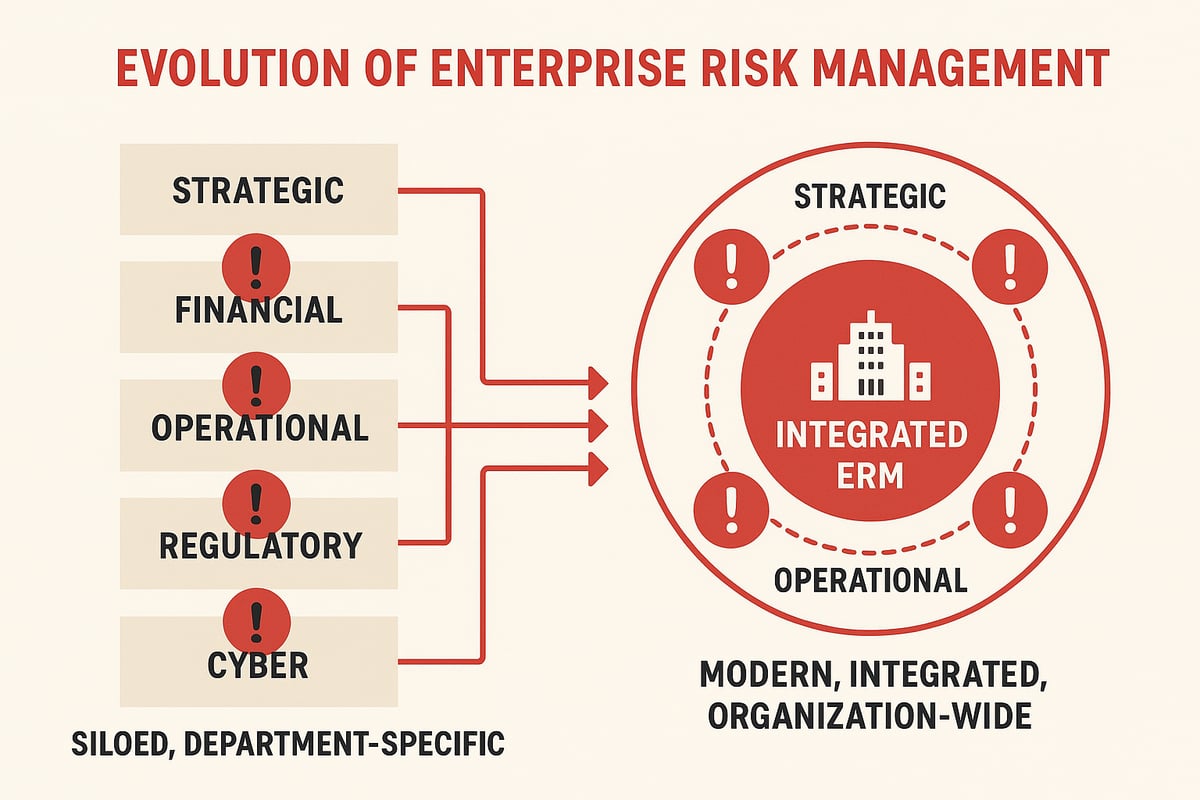
Enterprise risk management is an organization-wide, integrated approach to identifying, assessing, and mitigating risks that could impact business objectives. Unlike traditional risk management, which often works in isolated silos, enterprise risk management connects departments and functions, fostering collaboration and shared accountability.
The evolution of enterprise risk management accelerated after global disruptions like the pandemic and economic volatility. Companies that failed to adapt, such as Bed Bath & Beyond, struggled due to a lack of comprehensive risk planning. According to industry research, only a minority of businesses had robust enterprise risk management programs before the pandemic, highlighting the cost of being unprepared.
Types of Risks Addressed by ERM
Enterprise risk management covers a wide spectrum of risks, helping organizations anticipate and manage both familiar and emerging threats.
- Strategic risks: Shifts in the market, mergers and acquisitions, competition.
- Financial risks: Cash flow issues, investments, debt obligations.
- Operational risks: Supply chain disruptions, technology failures, process breakdowns.
- Compliance and regulatory risks: New laws and standards, such as Sarbanes Oxley and NIS2.
- Cybersecurity and data privacy risks: Increasing threats from AI-driven attacks and ransomware.
For example, recent semiconductor shortages have shown how operational risks can ripple through global supply chains, underscoring the need for strong enterprise risk management.
Why ERM is Essential for 2026
In 2026, enterprise risk management stands as a critical pillar for business sustainability and resilience. Proactive enterprise risk management allows organizations to anticipate potential issues rather than simply react to them, improving their ability to adapt and grow.
Effective enterprise risk management supports better governance, enhances transparency, and builds stakeholder trust. It also informs strategic decisions and ensures resources are allocated wisely. Recent data shows that organizations with mature enterprise risk management programs experience fewer losses and stronger governance, proving its value in today’s challenging environment.
Key ERM Frameworks and Standards
Several leading frameworks guide organizations in implementing enterprise risk management effectively. The most prominent include COSO ERM, ISO 31000, and the Casualty Actuarial Society framework.
Each framework offers unique strengths, with COSO focusing on internal controls and risk appetite, while ISO 31000 emphasizes a principles-based approach. Choosing the right framework and aligning it with your organization’s culture and objectives is essential. For a detailed comparison of COSO ERM and ISO 31000, visit this ISO 31000 and COSO ERM frameworks resource to help guide your selection and implementation process.
Step-by-Step Enterprise Risk Management Process for 2026
Building a resilient organization in 2026 means having a clear, actionable process for enterprise risk management. By following a proven step-by-step approach, we can ensure risks are not only identified but also managed proactively. Each step lays the foundation for a robust risk management culture, helping us navigate uncertainty with confidence.
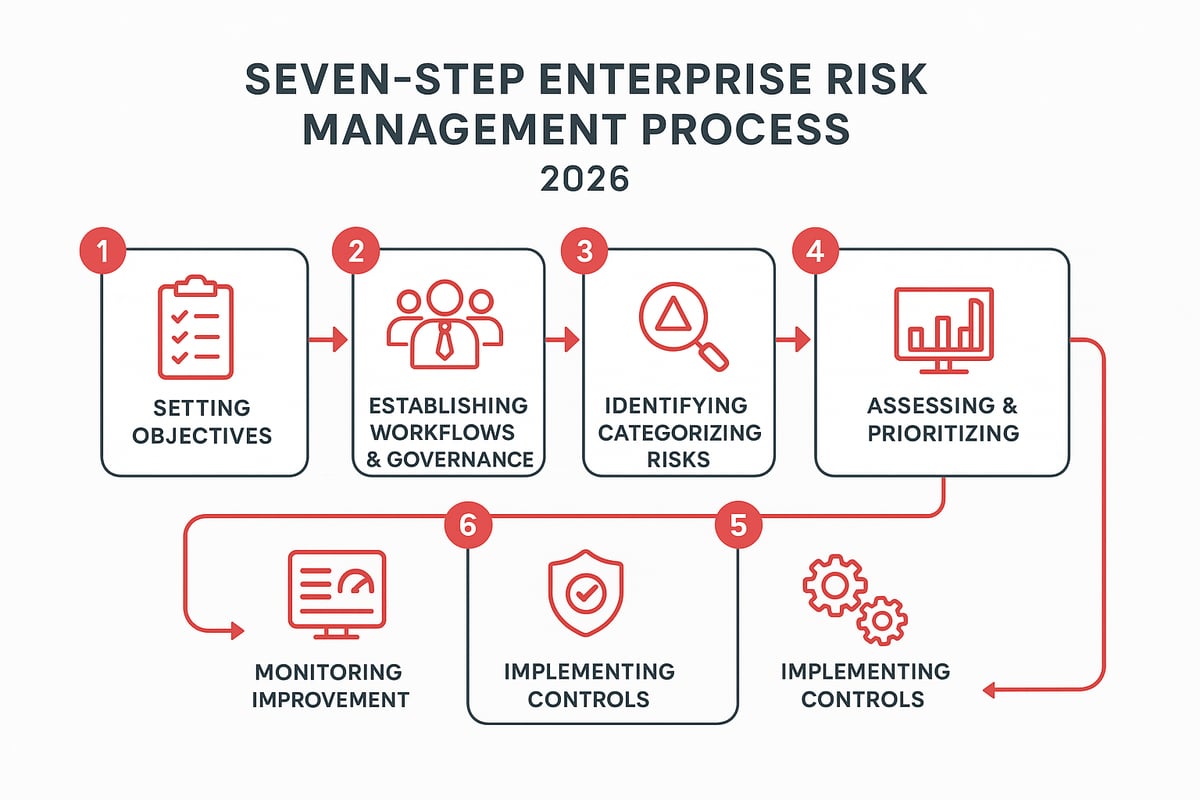
Step 1: Setting Risk Management Objectives
Every successful enterprise risk management journey begins with clear, strategic objectives. We need to define what we aim to protect and achieve, aligning risk goals with our overall business strategy. This includes examining our risk appetite—how much risk are we truly willing to take?
Involving the board and senior leaders from the start helps set a unified direction. For instance, when a company launches a digital transformation, aligning enterprise risk management objectives ensures technology investments support both innovation and security. Setting these aims early gives everyone clarity and focus.
Step 2: Establishing Internal Workflows & Governance
Strong governance is the backbone of effective enterprise risk management. We assemble cross-functional teams, bringing together voices from operations, IT, finance, and compliance. By clarifying roles and responsibilities, we avoid confusion and foster accountability.
A risk-aware culture is vital. Encouraging open communication about risks at every level helps us break down silos. Studies show organizations with robust governance structures consistently outperform peers in managing risk. Let’s make sure everyone knows their part in the process.
Step 3: Identifying and Categorizing Risks
Now it’s time to uncover what could threaten our objectives. We use risk workshops, interviews, and advanced data analytics to spot both obvious and hidden risks. Keeping a detailed risk register helps us track what we find.
We look at internal risks like process gaps or human error, as well as external threats such as market changes or geopolitical shifts. With emerging technologies like AI, new risks appear quickly, so our enterprise risk management process must stay agile and comprehensive.
Step 4: Assessing and Prioritizing Risks
Once risks are identified, we assess how likely they are to occur and how much impact they could have. Using both qualitative and quantitative tools, we prioritize what matters most. Key risk indicators (KRIs) and heat maps are helpful for visualizing where our biggest vulnerabilities lie.
For example, organizations have had to assess both the direct and lingering risks from global disruptions like COVID-19. By prioritizing, we ensure resources are focused on the most critical risks, making our enterprise risk management efforts more effective.
Step 5: Responding to Risks
Developing practical strategies is our next step. We decide whether to avoid, mitigate, transfer, or accept each risk. Creating actionable plans for high-priority risks is essential, and assigning clear owners with deadlines keeps progress on track.
For instance, to reduce supply chain dependency, companies might diversify suppliers or invest in local alternatives. This proactive approach is a hallmark of strong enterprise risk management, helping organizations stay resilient amid changing conditions.
Step 6: Implementing Controls and Mitigation Measures
Now we put plans into action. Preventative and detective controls are designed and integrated into business processes and technology systems. Regular monitoring ensures these controls stay effective over time.
A great example is implementing cybersecurity controls to protect sensitive data. For those wanting a deeper dive on this topic, check out the Cyber risk management essentials guide. Embedding these controls into our enterprise risk management system helps us respond swiftly to any threats.
Step 7: Monitoring, Reporting, and Continuous Improvement
The final step is all about staying vigilant. We establish ongoing monitoring and reporting using dashboards and regular reviews. Periodic audits help us spot gaps and adapt to new risks as they emerge.
Bringing in external consultants for independent reviews can offer valuable insights. By continuously refining our enterprise risk management process, we build a culture of learning and resilience, ensuring our organization is ready for whatever comes next.
Overcoming ERM Implementation Challenges
Navigating the path to strong enterprise risk management can feel overwhelming, but you are not alone. Many organizations face similar hurdles on their ERM journey. By understanding the most common challenges and using proven strategies, we can transform these obstacles into opportunities for growth and resilience.
Common Barriers to ERM Success
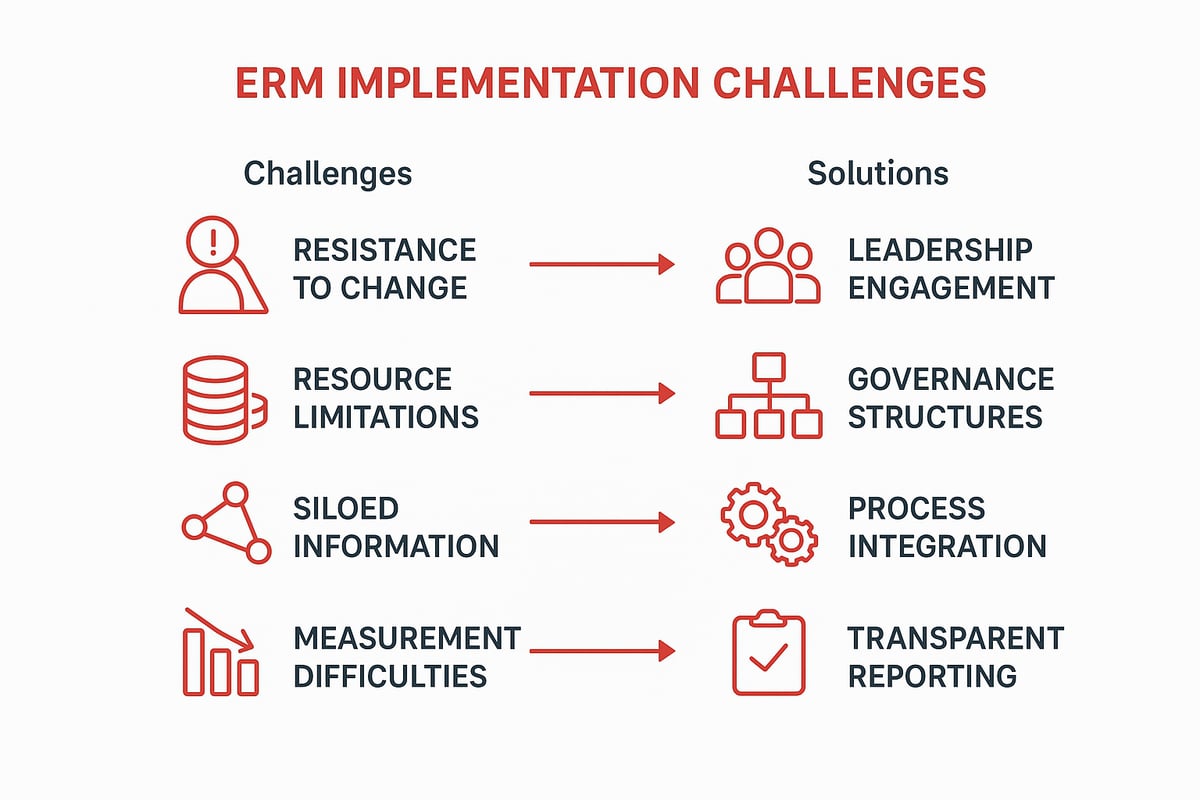
Implementing enterprise risk management is rarely straightforward. Many organizations encounter similar stumbling blocks, including:
- Resistance to change and a deeply rooted risk-averse culture
- Limited resources, whether it is time, skilled staff, or budget
- Siloed information, making cross-department collaboration tough
- Challenges in quantifying risk or demonstrating program ROI
These hurdles can slow progress, yet acknowledging them is the first step. By openly discussing these issues, teams can work together to find creative solutions and build momentum for enterprise risk management success.
Securing Leadership Buy-In and Support
Leadership engagement is crucial for effective enterprise risk management. When board members and executives understand ERM’s value, it becomes much easier to gain traction across the organization.
- Show how ERM supports strategic decisions and long-term goals
- Communicate clear business benefits, such as fewer losses and better compliance
- Involve senior leaders early and provide regular updates
When leaders champion ERM, it sends a powerful message. Their support helps secure resources, encourage participation, and drive a culture where risk management is everyone’s responsibility.
Integrating ERM with Business Processes
Enterprise risk management works best when it is woven into the fabric of daily operations. This means embedding ERM into planning, budgeting, and project workflows, rather than treating it as a separate task.
- Leverage technology to automate risk tracking and reporting
- Align ERM with performance management and incentives
- Foster collaboration between departments for a unified approach
Strong governance structures and compliance processes are key here. For practical advice on building these foundations, explore this governance and compliance guidance. By making ERM a natural part of business processes, organizations become more agile and better equipped to manage uncertainty.
Measuring and Communicating ERM Effectiveness
To keep enterprise risk management on track, organizations need ways to measure progress and share insights. Key performance indicators (KPIs) and risk indicators (KRIs) help leaders see what is working and where improvements are needed.
- Use dashboards and risk matrices for clear, transparent reporting
- Share risk updates with all stakeholders to build trust
- Regularly review metrics and adapt as the risk landscape evolves
Open communication ensures everyone is informed and engaged. By celebrating successes and learning from setbacks, teams foster a culture of continuous improvement in enterprise risk management.
Best Practices and Strategies for ERM Success in 2026
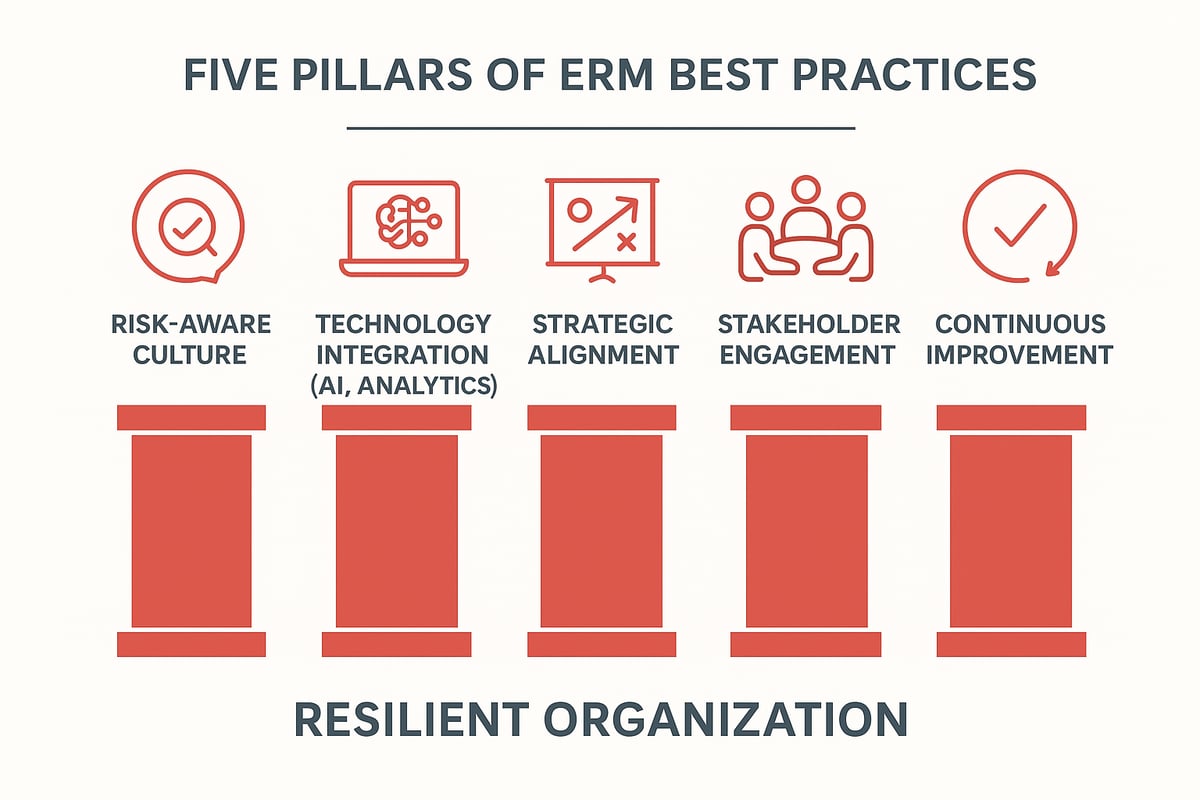
Building a successful enterprise risk management program in 2026 means more than just ticking boxes. It is about creating a foundation where everyone feels empowered to identify, discuss, and address risks together. Let us explore the practical steps and strategies that will help your organization thrive in an unpredictable world.
Building a Risk-Aware Culture
Fostering a risk-aware culture is the heart of effective enterprise risk management. When employees at every level feel comfortable discussing risks, your organization can spot issues early and respond quickly.
- Encourage open conversations about risks in team meetings.
- Provide regular training and awareness sessions.
- Celebrate the reporting of near-misses and lessons learned.
Cross-departmental risk workshops can break down silos and help everyone understand how their actions impact the bigger picture. By building trust and transparency, you create an environment where proactive risk management becomes second nature.
Leveraging Technology in ERM
Technology is rapidly transforming enterprise risk management. Risk management software can help track, analyze, and report on risks in real time, making it easier for teams to stay informed and responsive.
Integrating AI and advanced analytics uncovers hidden patterns and predicts potential threats before they escalate. Automation streamlines controls and monitoring, freeing up time for strategic work. For a deeper dive into how AI is revolutionizing risk identification, check out this guide on AI to transform risk assessment.
AI-powered tools are especially valuable for cyber risk assessment, helping organizations stay ahead of emerging threats in 2026 and beyond.
Aligning ERM with Organizational Strategy
To achieve real impact, enterprise risk management must be woven into your organization’s strategy. ERM should support business growth, innovation, and transformation, not stand apart as a siloed function.
- Involve ERM leaders in strategic planning sessions.
- Integrate risk analysis into major initiatives and investments.
- Use ERM insights to guide decisions during mergers, acquisitions, and expansions.
When ERM is part of the strategic conversation, your organization can pursue opportunities with confidence, knowing risks are understood and managed.
Enhancing Stakeholder Engagement
Great enterprise risk management involves more than just internal teams. Engaging employees, customers, suppliers, and even regulators creates a broader safety net and drives better outcomes.
- Invite stakeholders to participate in risk discussions and planning.
- Collect feedback to continuously improve risk processes.
- Conduct supplier risk assessments, especially after global disruptions.
This inclusive approach builds trust, ensures diverse perspectives, and helps your organization adapt to an ever-changing environment.
Continuous Improvement and Learning
Enterprise risk management is never static. Regularly reviewing and updating your ERM policies keeps your program resilient and relevant.
- Benchmark your practices against industry standards and peers.
- Learn from incidents, near-misses, and successes.
- Update risk playbooks based on post-event reviews.
A commitment to continuous improvement ensures your organization stays prepared, agile, and ahead of the curve—today and in the future.
Emerging Risks and Future Trends Shaping ERM in 2026
Staying ahead in enterprise risk management means understanding the new risks that are rapidly emerging. In 2026, organizations must adapt to an ever-shifting landscape, where innovation brings both opportunity and vulnerability. Let’s explore the trends and challenges shaping the future of ERM, so we can all build resilience together.
Cybersecurity and Data Privacy Risks
The digital world is evolving at breakneck speed, which means cybersecurity threats are multiplying just as quickly. From sophisticated ransomware to AI-driven attacks, the risks to sensitive data are greater than ever. Regulatory scrutiny is also intensifying, with frameworks like GDPR and NIS2 setting new standards.
For enterprise risk management, keeping up with these trends is essential. According to insights from Emerging risks for 2026, cyber threats and data breaches are among the top concerns for organizations. A single incident can damage reputation and finances, so proactive ERM strategies are a must.
ESG (Environmental, Social, Governance) and Reputational Risks
Environmental, social, and governance (ESG) factors are now at the heart of enterprise risk management. Investors, customers, and employees alike expect ethical and sustainable business practices. Failing to meet these expectations can spark backlash and harm your organization’s public image.
Managing ESG and reputational risks requires a holistic approach. This means integrating ESG into risk assessments, setting clear goals, and communicating transparently. In 2026, organizations that prioritize these values in their enterprise risk management programs will earn greater trust and loyalty from all stakeholders.
Supply Chain and Geopolitical Risks
Global events can disrupt supply chains overnight, making this one of the most dynamic areas for enterprise risk management. From climate disruptions to geopolitical conflicts, the need for resilient and diversified supply networks has never been clearer.
The Global Risk Management Survey 2025 highlights how supply chain risks are a top priority for organizations worldwide. By identifying vulnerabilities and building contingency plans, ERM helps companies adapt and thrive, even when the unexpected occurs.
Regulatory and Compliance Landscape
Regulations are constantly evolving, so enterprise risk management must remain agile. New laws, such as updated SOX and data privacy standards, increase the complexity of compliance. Non-compliance can result in hefty fines and loss of stakeholder trust.
To keep pace, organizations should embed compliance into their ERM frameworks. Regular monitoring, staff training, and proactive adjustments to policies enable businesses to meet new requirements. In 2026, staying compliant is not just about avoiding penalties, it’s about building a foundation for sustainable growth.
Real-World Case Studies and Lessons Learned
Real-world experiences are some of the best teachers when it comes to enterprise risk management. By looking at both successes and failures, we can discover what truly drives resilience and where organizations often stumble. Let’s explore what we can learn from others’ journeys.
Success Stories in ERM Implementation
Some organizations have turned enterprise risk management into their competitive edge. Companies in sectors like finance and manufacturing have adopted leading frameworks such as COSO ERM and ISO 31000, allowing them to anticipate threats and seize new opportunities. For instance, one global retailer used a cross-functional risk team to spot early signs of supply chain disruption and quickly diversify suppliers, maintaining business continuity when competitors faltered.
These successes are often built on a foundation of strong policies, regular risk reviews, and the use of best cybersecurity frameworks to protect digital assets. The result? Fewer surprises, improved financial performance, and greater trust from stakeholders.
Notable Failures and What Went Wrong
Unfortunately, not every story has a happy ending. Bed Bath & Beyond’s collapse is a cautionary tale about the dangers of neglecting enterprise risk management. The company failed to see the warning signs of changing consumer habits, digital disruption, and supply chain vulnerabilities.
Instead of integrating risk management into decision-making, the organization relied on outdated approaches and missed critical opportunities to adapt. This reactive mindset left them exposed to market shifts and eventually led to their downfall. The lesson is clear: ignoring enterprise risk management can have lasting consequences.
Key Takeaways for 2026 and Beyond
What can we learn as we look ahead? First, enterprise risk management must be proactive and adaptable. Organizations that regularly update their risk assessments and encourage open communication are better prepared for uncertainty. Embracing technology, such as AI and data analytics, helps organizations anticipate risks and respond faster. For more on how automation is shaping the future, see AI’s role in risk management.
To future-proof your organization, focus on leadership support, continuous learning, and embedding enterprise risk management into your culture. This approach will help you navigate whatever challenges 2026 brings.
As you look to put these ERM strategies into action and future-proof your organization for 2026, remember—you’re not alone on this journey. We all face a fast-changing risk landscape, and having a supportive community makes a world of difference.
If you’re ready to keep learning, share your experiences, and connect with other security leaders who truly get it, I’d love for you to join us. Together, we can turn real-world insight into practical steps that build resilience and confidence.
Join the conversation in the Join CISO Launchpad Community.